Academic Integrity as the Foundation of High-Quality Research by Future Teachers
The group is supervised by Liudmyla Varianytsia, Candidate of Pedagogical Sciences and Associate Professor of the Department of Early Childhood and Preschool Development.
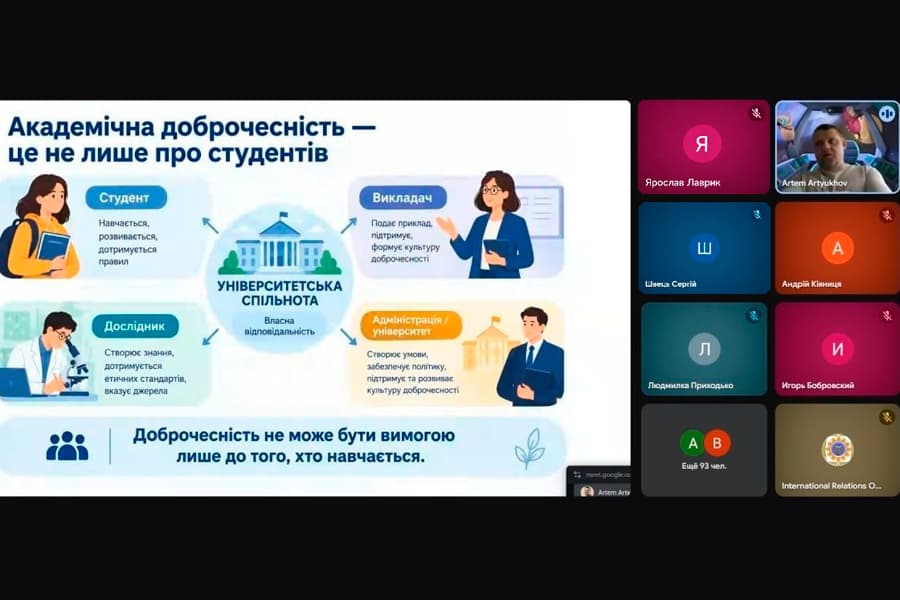
During the meeting, Bachelor’s and Master’s students discussed the importance of academic integrity for teachers’ educational, research, and future professional activities. Particular attention was paid to responsible use of scholarly sources, the reliability of research findings, ethical aspects of working with participants in the educational process, and the use of generative artificial intelligence.



As part of the round table, students presented reports addressing various aspects of academic integrity.
H. Tkachenko examined academic integrity as a value and principle underlying the work of a future teacher-researcher, emphasizing honesty, trust, fairness, respect, and responsibility.
S. Pokhvala outlined the main forms of academic misconduct, including plagiarism, self-plagiarism, fabrication and falsification of research results, unjustified appropriation of authorship, and the use of unreliable sources.
I. Katrenych addressed the culture of working with scholarly information, focusing on searching for and critically selecting sources, verifying their reliability, and using correct citation and paraphrasing practices.
Y. Pokhvala discussed ethical aspects of educational research, including voluntary participation, confidentiality, personal-data protection, and the responsible use of information obtained when working with children, teachers, and parents.
Master’s students A. Kutiiepova and A. Uchvatova raised current issues concerning the use of generative artificial intelligence and the ethical handling of research findings. Participants discussed the potential of AI as an auxiliary research tool, as well as the risks associated with unreliable information, fabricated sources, and replacing independent work with AI-generated content.
During the discussion, participants considered the responsible use of scholarly sources, the reliability of research findings, and the appropriate boundaries for the use of artificial intelligence.
The meeting of the “Territory of Professional Growth” research group provided an opportunity for meaningful academic dialogue, an exchange of ideas, and the development of a responsible attitude towards one’s own research activities.
Faculty of Pedagogy and Psychology