Open Lecture at the Department of History and Archaeology: Contemporary Interpretations of the National Liberation War
The lecture was delivered by Yevheniia Shevtsova, PhD in History and Archaeology, Senior Lecturer at the Department of History and Archaeology.
The event was attended by members of the Department of History and Archaeology, the leadership of the Faculty of Social and Humanitarian Sciences, representatives of the Luhansk Regional Museum of Local History, and undergraduate and master’s students enrolled in the Secondary Education (History and Civic Education) programme. Other participants interested in Ukrainian history and its contemporary scholarly interpretation also joined the lecture.
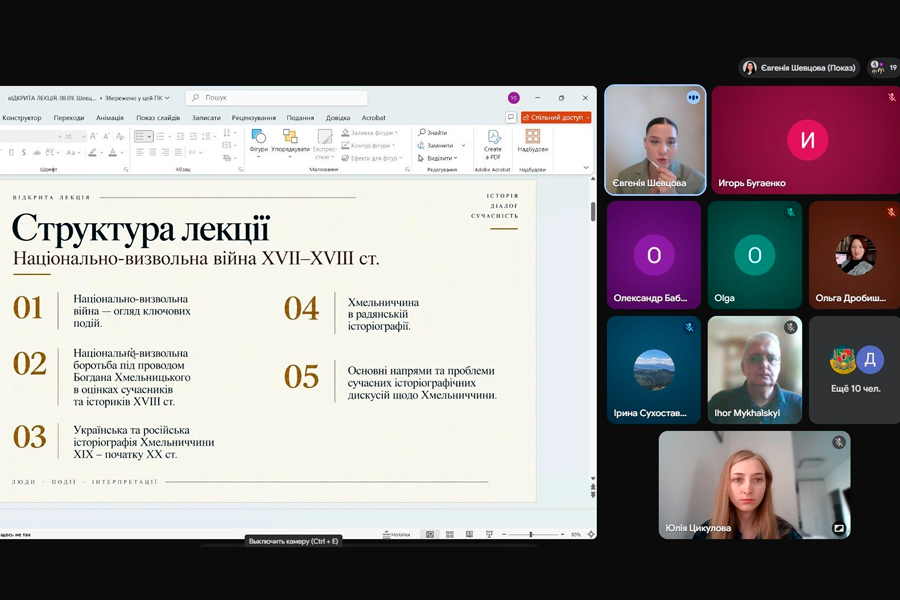
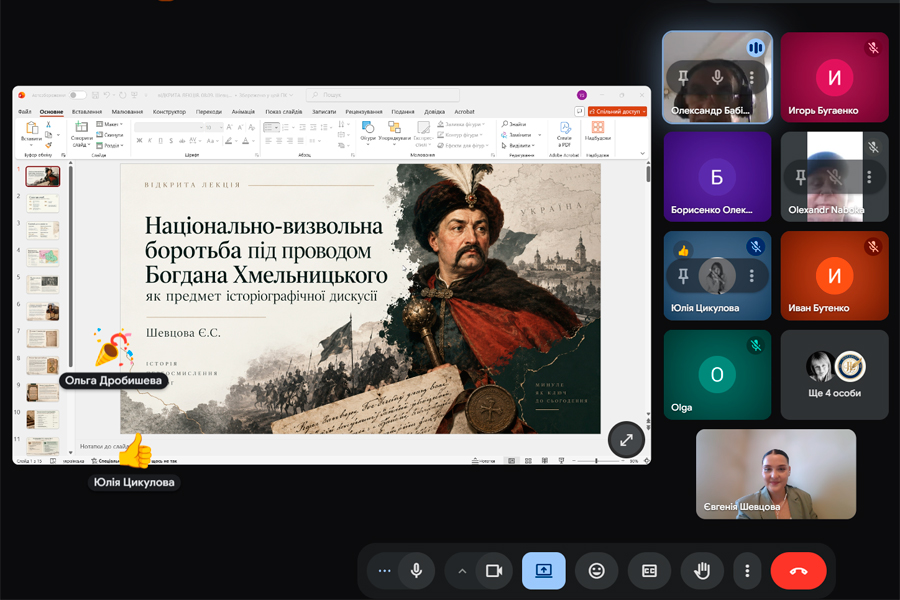
The topic is highly relevant while also presenting a complex subject for academic study. The events of the mid-17th century, the figure of Bohdan Khmelnytskyi, the processes of Ukrainian state-building, and the history of Ukrainian-Muscovite relations have for centuries been subject to different - and at times fundamentally opposing - historical interpretations.
A distinctive feature of the lecture was its strong academic focus, broad chronological scope, and systematic examination of how approaches to interpreting the events of the Khmelnytsky era changed across different historical periods. The clear structure of the lecture not only presented extensive factual material but also demonstrated the evolution of historical knowledge and changes in scholarly assessments of some of the most significant events in Ukrainian history.
Importantly, the material was not presented simply as a collection of dates, events, and historical figures. The lecture focused on comparing different scholarly approaches, analysing historiographical concepts, and tracing the development of interpretations of the issues under discussion.
For students, the open format of the lecture provided an opportunity to observe the practical application of contemporary approaches to teaching history. Effective historical education involves not only acquiring a substantial body of knowledge but also developing the ability to analyse information, compare scholarly perspectives, work with historiographical sources, and independently explore historical issues.
This is particularly important for students of the Secondary Education (History and Civic Education) programme, whose future professional activities will involve communicating historical knowledge, addressing complex and controversial topics, and helping school students develop the ability to analyse information and formulate well-grounded opinions.
At the same time, the open format created an opportunity for professional communication among members of the academic community, museum professionals, and students. The participation of representatives of the Department of History and Archaeology, the Faculty of Social and Humanitarian Sciences, the Luhansk Regional Museum of Local History, and other attendees transformed the lecture into a broader academic discussion. The topic naturally generated considerable interest among the audience.
Complex periods of history - particularly those that have long been subject to different political and scholarly interpretations - require careful analysis of historiographical research, comparison of scholarly arguments, and the continued development of research approaches.
Such events therefore serve not only as a means of presenting academic material but also as a space for intellectual exchange, professional dialogue, and scholarly discussion.
At the conclusion of the lecture, the speaker summarised the main points and key aspects of the topic, highlighting its complexity, multidimensional nature, and ongoing scholarly debate. Participants were also provided with a list of recommended academic publications and other materials for further independent study.
Department of History and Archaeology