Open Haiku Writing Workshop Held in Lubny
The event focused on the practical exploration of the fundamentals of haiku writing – a traditional Japanese poetic form distinguished by its conciseness, attention to concrete detail, and ability to convey significant emotional and semantic content through a few carefully selected images.
Unlike a conventional theoretical class, the workshop involved active student participation at every stage of the process. Participants not only learned about the distinctive features of Japanese poetry but also immediately put the suggested techniques into practice: they observed, recorded what they noticed, selected images, created their own texts, and edited them.
The workshop began with a simple task: participants were asked to look carefully around them for several seconds and record something they could see, hear, or feel. It might be a ray of sunlight on a windowsill, a sound outside the window, wet asphalt, the shadow of a tree, the sound of footsteps, or the movement of a curtain. It was from such seemingly insignificant details that participants began creating their first poetic images.
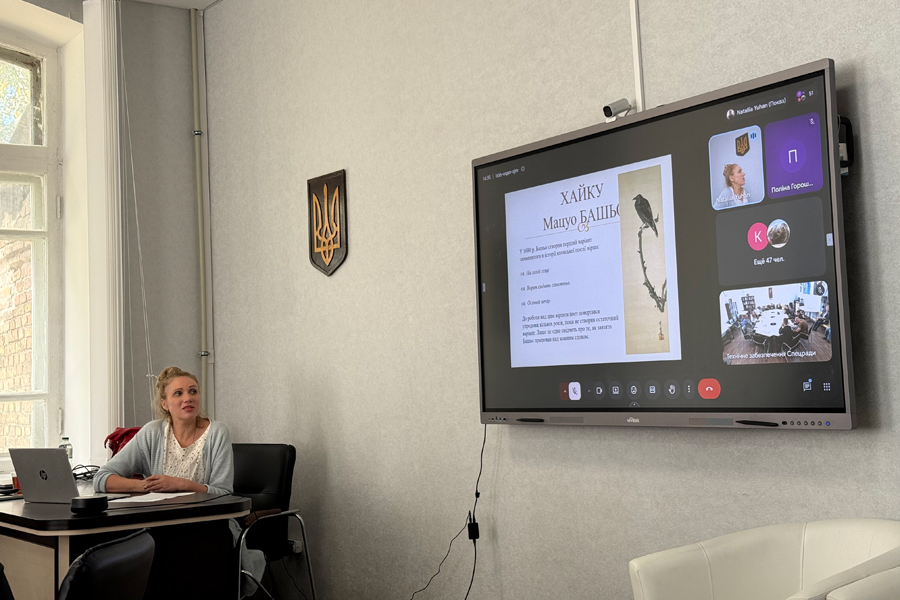
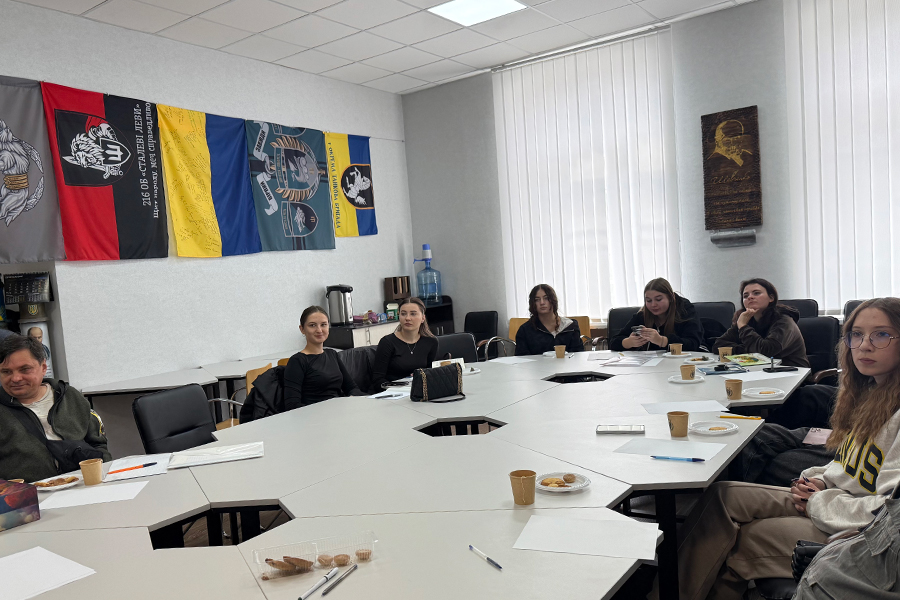

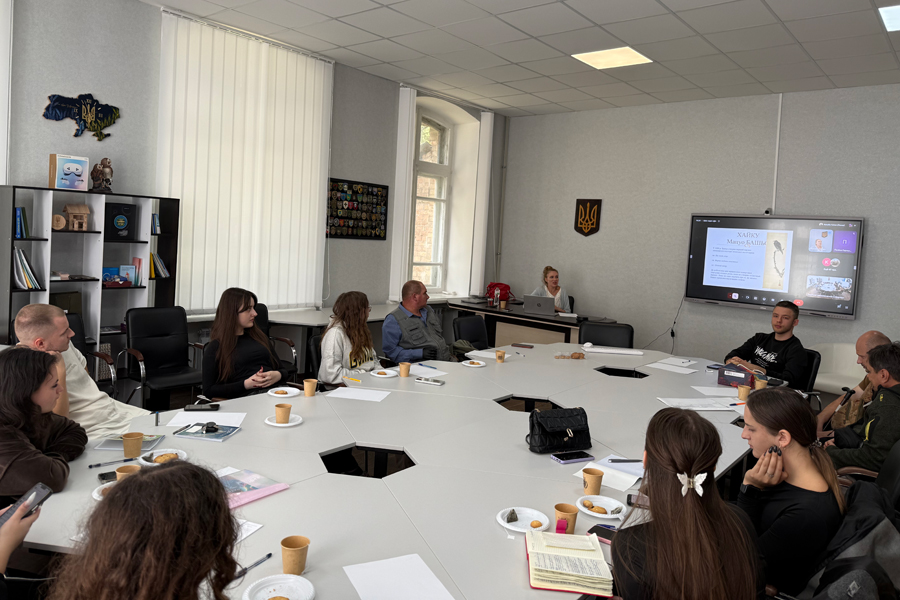
During the workshop, students were introduced to the main features of traditional Japanese haiku: its three-part structure, the seasonal reference known as kigo, and the structural pause or shift known as kire. At the same time, particular attention was given to the possibility of creatively adapting this poetic form to Ukrainian cultural experience.
One of the key activities was the “Don’t Name It!” exercise. Students learned to convey such concepts as sadness, loneliness, love, fear, or autumn without naming them directly. Instead of explaining an emotion, they had to find a specific situation or object through which the reader could experience it.
Another important part of the workshop was “Hunting for a Moment.” Participants looked for small yet expressive situations around them: a leaf stuck to a shoe, the reflection of the sky in a puddle, a lonely cup on a windowsill, the movement of the wind, or a scarf left behind on a bench. They then learned how to transform these observations into poetic material.
The next stage focused on concentrating the image. From an entire observation, students selected only a few key words and identified what was happening between them. The “two frames” technique was also used to construct the composition: the first images create a particular situation, while the final line introduces an unexpected detail or changes the way the preceding images are perceived.
Special attention was given to Ukrainian seasonal imagery. Viburnum, cherry trees, stubble fields, black soil, mist over a river, the first snow, autumn wind, and other elements of the Ukrainian cultural landscape can serve as the basis for haiku, giving the traditional poetic form a distinctly Ukrainian resonance.
Working with the texts they had already written was another important stage of the workshop. During the “Cut It in Half” exercise, students shortened their haiku by removing words that did not contribute additional imagery. This practice helped them understand that conciseness is one of the defining artistic features of haiku and that every word should be necessary.
As a final task, participants created their own haiku in three thematic areas: “Nature,” “The Human Being,” and “Ukrainian Space.” Their poetic attempts included images of home, roads, railway stations, fields, cities, memory, encounters, and waiting.
The workshop concluded with a reflection session. Students discussed what they had found most challenging in writing haiku, how a text changes when unnecessary words are removed, and whether it is possible to convey a strong feeling without naming it directly.
Summing up the workshop, Professor Nataliia Leonidivna Yuhan emphasized that haiku is an art of attentive observation and of discovering significance in the ordinary. Three lines can be enough to create a complete image if they contain only what matters most.
The open workshop gave participants an opportunity not only to become acquainted with the Japanese poetic tradition but also to experiment with creative writing, develop their capacity for visual and imaginative thinking, and learn to notice the poetic potential of the world around them more attentively.
Faculty of Social Sciences and Humanities