Extended Meeting of the Circle "Innovative Technologies for Teaching Geography"
On May 1, 2026, a meeting of the scientific circle "Innovative Technologies for Teaching Geography" was held at the Department of Chemistry, Geography and Earth Sciences of the Faculty of Natural and Agrarian Sciences. The key topic of the meeting was the use of virtual excursions and immersive technologies in modern schools.
The main feature of the event was the participation of the professional community - geography teachers and university graduates. They acted as experts, evaluating the latest methodological developments of the department in terms of their real effectiveness in school classrooms.
The participants discussed how to turn passive viewing of a map into active exploration of space, developing students' analytical and research skills. Today, virtual trips are an indispensable tool, especially in conditions when physical excursions are limited.

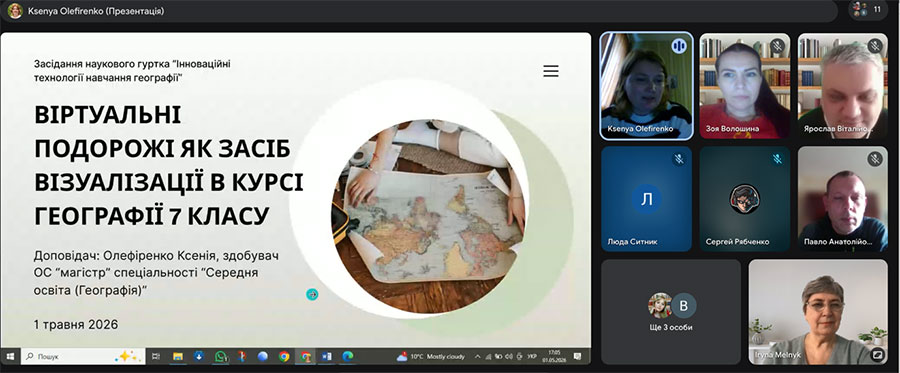
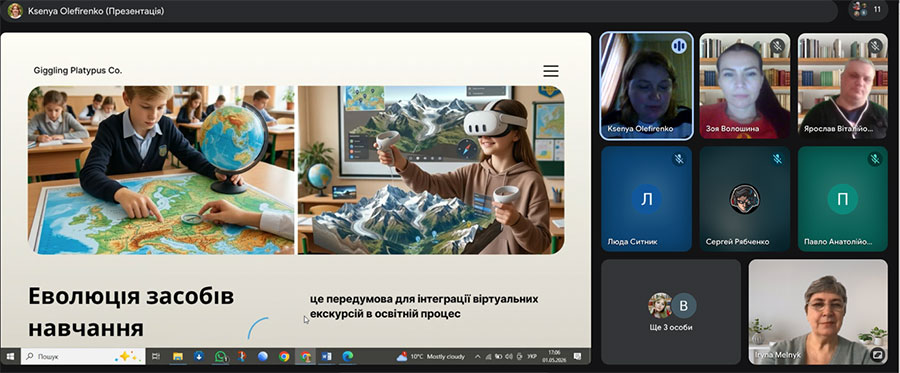
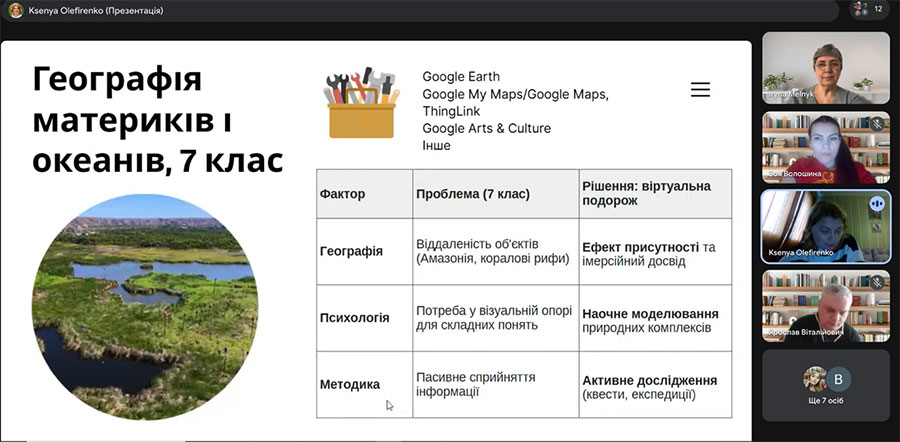
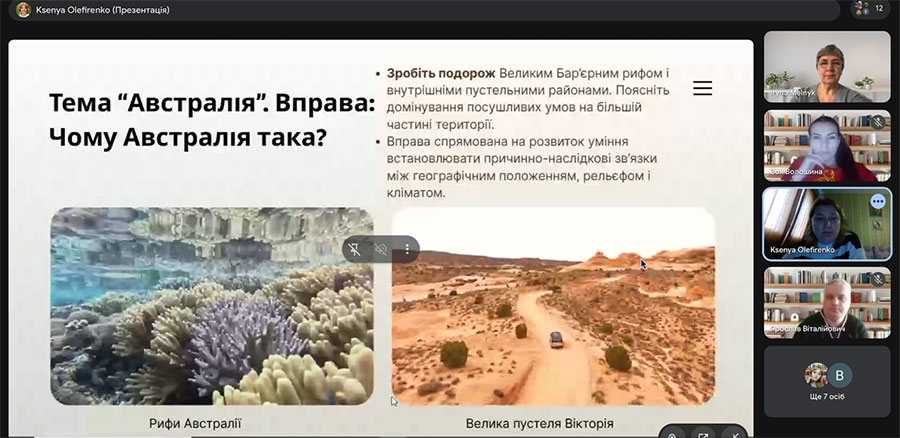

During the meeting, specific cases were presented.
The master's student Ksenia Olefirenko (major: Secondary Education. Geography) presented a thorough report in which she revealed the theoretical aspects of the use of immersive technologies. She analyzed the very concept of "virtual travel" as a complex didactic complex and substantiated the methodology for its application when studying the geography of continents and oceans (Africa, South America, Australia).
Iryna Melnyk, associate professor of the department, presented the possibilities of using 3D context in Google Earth. This technology allows you to create the effect of complete immersion, helping students better understand spatial relationships and form holistic mental maps.
The involvement of teachers as experts made it possible to adapt scientific developments to the needs of a modern school. Teachers noted that the use of immersive technologies not only increases interest in the subject, but also contributes to the development of digital literacy of students.
The joint work of lecturers, students and teachers has confirmed: innovations in education become effective only when they are tested in real practice. The department continues to develop this direction, preparing future specialists for work in a modern digital environment.
Department of Chemistry, Geography and Earth Sciences