Continuation of the III International Conference
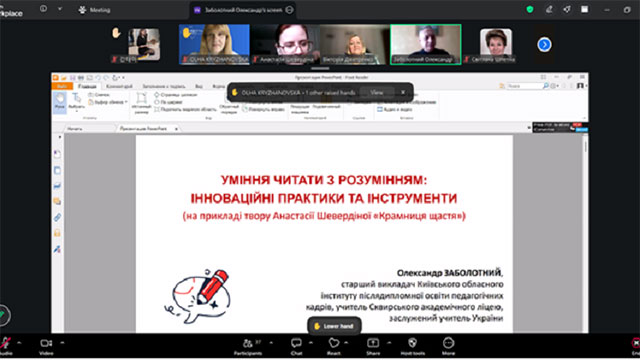
The creative meeting presented by Professor Viktoriia Dmytrenko was particularly inspiring. The guest of the morning session was the incredible Anastasiia Sheverdina — a writer, screenwriter, artist, PhD in Philology, and a graduate of our faculty. A remarkably pleasant surprise for the guest was a visit from her university mentor. Her former supervisor, now Doctor of Philological Sciences, Professor, and Head of the Department of Ukrainian Literature, Comparativism, and Grinchenkovism at Borys Grinchenko Kyiv Metropolitan University, Olena Brovko, came to congratulate her graduate. This meeting was a warm testament to the fact that the bond between teacher and student endures through years and academic achievements. The discussion of her work "The Shop of Happiness" (Kramnytsia Shchastia), which is currently included in the New Ukrainian School (NUS) curriculum, drew significant interest. Oleksandr Zabolotnyi, Honored Teacher of Ukraine and teacher-methodologist, joined the conversation to share unique methodological cases for studying Anastasiia's work in schools.
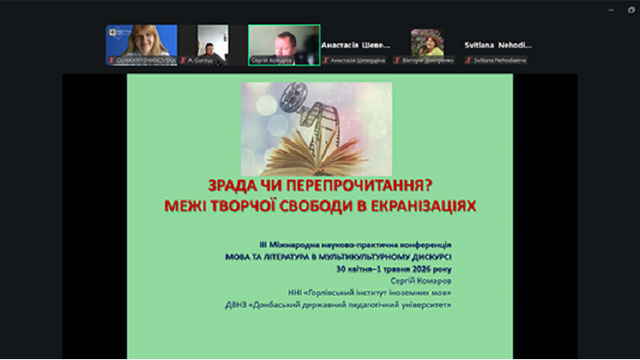


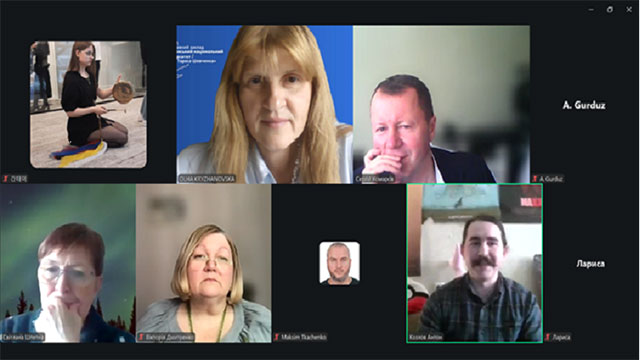
The issue of the boundaries of creative freedom was discussed during the round table "Betrayal or Reinterpretation? The Limits of Creative Freedom in Film Adaptations." The speakers were Serhii Komarov (Doctor of Philological Sciences, Professor, Head of the Department of World Literature at GIIM SHEI DSPU) and Anton Kozlov (writer and film researcher). Participants engaged in a heated debate over whether a director has the right to "correct" a classic and where interpretation ends and the distortion of the author’s intent begins.
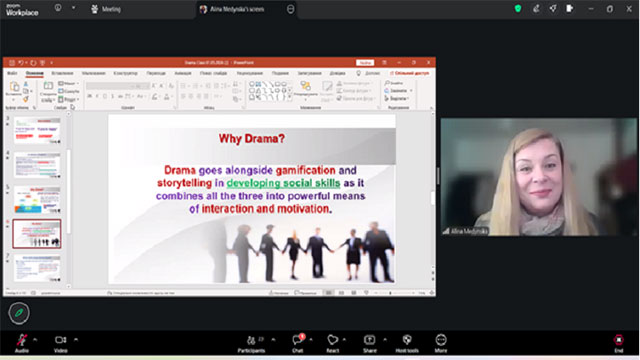
The final chord of the day was an interactive workshop by Alina Medynska, PhD and Senior Lecturer at the Department of Foreign Languages. During the session "Drama Class: Developing Social Skills Through Drama," participants practiced theatrical techniques to boost soft skills, overcome language barriers, and build self-confidence.
The second day of the conference proved that philology today is not just about texts, but about live communication, creative industries, and constant forward motion. We thank everyone who was with us!
Based on information from the Department of Literary Studies and Oriental Philology