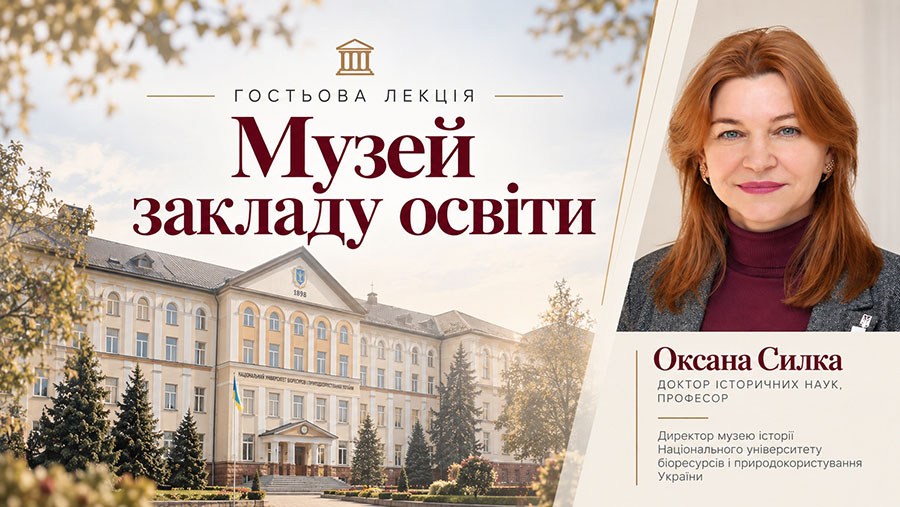
Guest Lecture: “Museum of an Educational Institution”
The guest lecturer was Oksana Sylka, Doctor of Historical Sciences, Professor, and Director of the Museum of the History of the National University of Life and Environmental Sciences of Ukraine.
During the meeting, students had the opportunity to learn not only about the theoretical aspects of museology but, above all, about the practical operation of a museum within an educational institution. Oksana Sylka spoke about the specific features of running a university museum, its place within the structure of an educational institution, its main areas of activity, and work with museum materials.
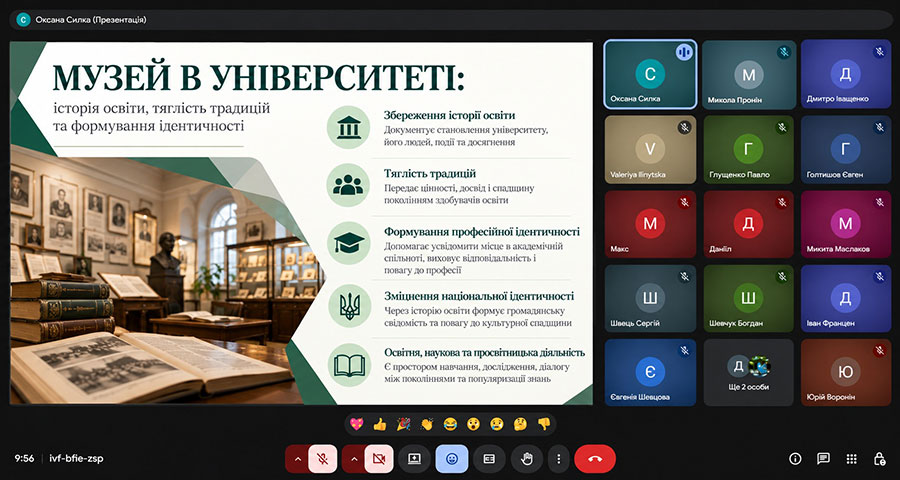
Special attention was also devoted to educational and guided-tour activities, including the preparation and conducting of tours, working with different audiences, and presenting the history of a university through museum objects, documents, photographs, and other materials.
An important part of the lecture was a discussion of how museums function directly within educational institutions. This is particularly relevant for future history teachers, as a school or university museum often requires a specialist who is simultaneously a teacher and has expertise in history, working with historical sources, exhibition development, and guided-tour activities. In professional practice, a history teacher often becomes the head of such a museum or participates in its establishment and organisation.
The meeting was particularly valuable for students pursuing a Master’s degree, as at this stage of their studies they are already moving from acquiring theoretical knowledge towards independent research and professional work.
Knowledge of museum management, exhibition development, collections, and working with visitors can be directly applied during teaching practice, in the preparation of educational materials, the organisation of extracurricular activities, and the implementation of students’ own research projects as part of their Master’s theses. In particular, Yurii Voronin, a second-level (Master’s) student, is working on a qualification thesis devoted to the museum as an educational space.
During the meeting, he had the opportunity to ask the lecturer questions and discuss issues directly related to his research.
Events of this kind are a traditional part of the Faculty’s activities and an important element in the development of educational programmes. The content of educational components, including elective courses, is updated with consideration for current trends in the relevant professional field, emerging research areas, and the practical experience of specialists.
The involvement of practitioners and scholars in the educational process helps to keep the curriculum up to date, broaden students’ professional competencies, and strengthen the direct connection between university education and students’ future professional activities.
Yevheniia Shevtsova
Programme Guarantee Officer
Lecturer, “Fundamentals of Museology”