Current Project Activities of University Researchers
The thematic scope ranges from human potential, veteran policy and historical memory to digital heritage, ecology, agricultural sciences and mathematical modelling.
One of the largest-scale initiatives was an application to participate in the development of the Roadmap for Research Infrastructures of Ukraine within RIFF – “Ukrainian Research Infrastructure for Human Potential, Societal Resilience and Transformational Development” (institutional coordinator – Iryna Myhovych, Doctor of Pedagogical Sciences, Professor, Acting Vice-Rector for Research and Academic Affairs). The project idea focuses on creating a national environment in which data on societal transformations will become the basis for responsible management decisions. The future infrastructure is intended to bring together long-term datasets on veterans, internally displaced persons, young people, Ukrainians abroad, educators, researchers and communities. The National Human Potential Dashboard of Ukraine, proposed as one of the project outputs, will make it possible not only to record changes but also to track their dynamics, assess the effectiveness of policies and forecast post-war recovery scenarios. The application is currently under evaluation.
A significant area of work was participation in the competition of the Ministry of Education and Science of Ukraine for projects of fundamental and applied scientific research and scientific and technical developments. University teams submitted nine applications, each combining academic rigour with clear societal relevance.
Fundamental Research:
Olena Karaman, Doctor of Pedagogical Sciences, Professor, Corresponding Member of the National Academy of Educational Sciences of Ukraine, Rector – “An Ecosystem Model of Post-Traumatic Growth of War Veterans amid Protracted Military Conflict: Integrating Veteran Experience into Community Capital.” The project proposes viewing veteran experience not only through the prism of trauma but also as a resource for community development.
Oleksandr Naboka, Doctor of Historical Sciences, Professor, Head of the Department of History and Archaeology, Faculty of Social Sciences and Humanities – “Encyclopaedia of the History of Luhansk Region: Systematisation of Historical Heritage and Preservation of the Region’s Historical Memory.” This is an important step towards preserving the historical voice of Luhansk Region and countering attempts to distort or erase it.
Anton Bader, Doctor of Political Sciences, Professor at the Department of Political Science and International Relations, Faculty of Social Sciences and Humanities – “The Cognitive Dimension of Ukraine’s National Resilience amid Information Aggression.” The focus is on society’s ability to maintain critical thinking, resilience and unity in an environment of information threats.
Applied Research:
Iryna Myhovych, Doctor of Pedagogical Sciences, Professor, Acting Vice-Rector for Research and Academic Affairs – “Evidence-Based Management of Human Potential Development among Persons at Increased Risk of Socio-Economic Vulnerability through the Internationalised Design of Educational Solutions and Support for Sustainable Career Pathways.” The application is aimed at ensuring that educational solutions for vulnerable groups are based on data, international experience and people’s actual needs.
Olha Kostiuk, Candidate of Philosophical Sciences, Associate Professor, Head of the Department of Design and Media Production, Faculty of Arts – “Preservation of Monumental Art Objects in Poltava Region through Digital Technologies.” The project combines cultural memory with digital tools for its documentation and preservation.
Iryna Prodan, Candidate of Pedagogical Sciences, Associate Professor, Dean of the Faculty of Arts – “The Visual Code of Resistance: Transformation of Ethnic Motifs in Contemporary Ukrainian Digital Art as a Means of Constructing National Identity.” The research conceptualises art as a language of cultural resistance and affirmation of Ukrainian identity.
Kateryna Hlukhovtseva, Doctor of Philological Sciences, Professor at the Department of Ukrainian Language and Journalism, Faculty of Social Sciences and Humanities – “Ecolinguistic Principles of Shaping Environmental Awareness and a Culture of Sustainable Development in Contemporary Literary, Mass Media and Conversational Discourses.” The team will investigate how language shapes environmental thinking and a responsible attitude towards the future.
Andrii Kokhan, Doctor of Agricultural Sciences, Professor at the Department of Biology and Agronomy, Faculty of Natural and Agricultural Sciences – “Theoretical Substantiation of the Restoration of Degraded Soils in Poltava Region through Organic Carbon Stock Management under Climate Change.” The project addresses the simultaneous challenges of land degradation, climate change and food security.
Yurii Kozub, Doctor of Technical Sciences, Professor at the Department of Mathematics and Computer Science – “Modelling Nonlinear Deformation Processes of Anisotropic Structures under Non-Stationary Loading Based on the Finite Element Method.” The application develops mathematical tools for solving complex engineering problems.
All nine projects have been submitted. In accordance with Order No. 934 of the Ministry of Education and Science of Ukraine dated 15 June 2026, the results are expected to be announced by 30 December 2026.
A separate dimension of the University’s project activities is represented by the Erasmus+ programme. The RESQUE-UA – Resilient Systems for Quality and Excellence in Displaced Universities in Ukraine project, submitted by Kherson State University (with overall management on behalf of Luhansk Taras Shevchenko National University carried out by Vitalii S. Kurylo), received 83 points out of a possible 100, which is a high result for CBHE projects. The application is currently included on the reserve list and may receive funding if additional funding is allocated to the Erasmus+ programme. This is the first interim result among the applications listed and, at the same time, evidence of the high competitiveness of the proposed idea, since for displaced Ukrainian universities, the issue of resilient quality assurance systems is not an abstract management problem but a daily practice of preserving the academic community, the educational process and institutional capacity amid war.Work is currently underway on another international project application – to the Horizon Europe programme under the thematic area “Supporting post-conflict democracy and reconstruction”. Iryna Myhovych will coordinate the participation of Luhansk Taras Shevchenko National University in the preparation of the project. The application is scheduled for submission by 23 September 2026. The future project is intended to cover four interconnected objectives. The first concerns the development of effective strategies for sustainable peace and democratic reconstruction at the national and local levels, in compliance with the principles of inclusiveness, equality, security, human rights, integrity and anti-corruption. The second area envisages the preparation of evidence-based recommendations for policymakers regarding international cooperation, EU support for democracy and the involvement of civil society in reconstruction processes. The third will strengthen the capacity of local civil society organisations and communities – primarily those representing people in vulnerable situations – to provide recommendations and support to educators, the media, public administrators and other participants in reconciliation, accountability and sustainable peacebuilding processes. The fourth objective focuses on returning veterans and war-affected vulnerable groups to full participation in life through comprehensive support programmes capable of simultaneously addressing people’s socio-economic and psychological needs and facilitating their successful reintegration into democratic society. For a university with its own experience of displacement and a long-standing record of work on human potential, societal resilience and veteran reintegration, participation in such an initiative is a logical continuation of its research and international activities.
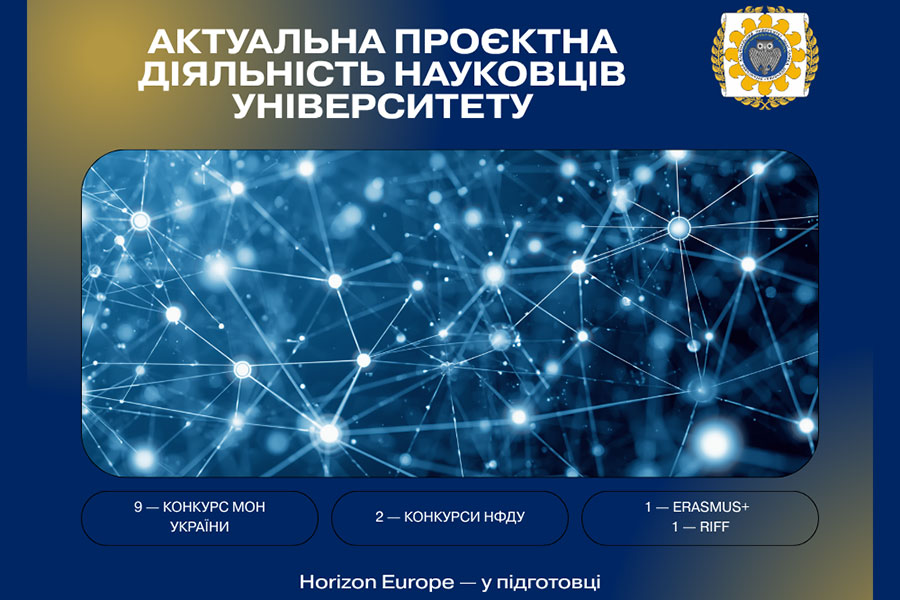
Two more applications by University researchers are participating in competitions of the National Research Foundation of Ukraine: (1) “Formation of Adaptive Social Leadership in a VUCA World: An Internationalised Pedagogical Model for the Development of Ukraine’s Human Potential” – a project authored by Iryna Myhovych and submitted to the competition for annual grants of the President of Ukraine for Doctors of Sciences aged up to and including 45 to conduct scientific research and development. The application is currently under evaluation. (2) A project on the protection of human rights in temporarily occupied territories and ensuring the rights of internally displaced persons amid war: institutional and security dimensions was submitted under the coordination of Vitalii S. Kurylo to the “Advanced Fundamental Science in Ukraine 2027-2029” competition. It is also currently under evaluation.
Today, the success of university research is measured not only by the number of publications. It is manifested in the ability of University researchers to identify a problem before it becomes critical; to bring together different scientific schools around it; to find partners; and to translate a complex idea into the language of a convincing project. The submitted projects demonstrate that precisely such a culture is taking shape at the University – one that is open to interdisciplinarity, international partnership and responsibility to society.
We wish all project teams success in the next stages of the competitive selection process, high scores and well-deserved victories! May every application receive support and every idea have the opportunity to become a real research project.
According to information provided by
Acting Vice-Rector for Research and Academic Affairs Iryna MYHOVYCH